



.svg)

osing the wrong product to sell is the fastest way to burn through your ad budget. AI product research tools have changed how serious dropshippers validate ideas — instead of guessing, you're working from real store data, ad performance metrics, and live trend signals.
But with several tools on the market, they're not all equally suited to every stage of your business. Below is a hands-on comparison of the five leading AI-powered product research tools for dropshipping in 2026, broken down by what actually matters: data depth, ease of use, pricing, and how well each integrates with your existing workflow.
How we compared these tools
Each tool was evaluated on five criteria:
- Data coverage — how many stores, ads, and products are tracked
- AI accuracy — how reliably the tool surfaces genuinely profitable products
- Ease of use — how quickly a new user can find actionable insights
- Pricing — free tiers, monthly costs, and value at each tier
- Extras — supplier links, competitor tracking, Shopify integration
1. SP Product Researcher (Service Points)

SP Product Researcher takes a different approach from most tools: instead of showing you data on individual store listings, it aggregates everything at the product level. You see every store selling a specific item, every Facebook ad running for it, and trend data across all of them at once.
The tool monitors over 100,000 active dropshipping stores daily using AI algorithms to identify patterns that would be impossible to spot manually. Metrics like ad impressions, estimated ad spend, runtime, and number of active ads let you validate whether a product is genuinely performing or just getting tested.
What makes it stand out in a direct comparison is the completeness of the picture. Other tools show you one store or one listing. SP Product Researcher shows you every store and listing for the same product, so saturation analysis is far more accurate.
It's free for users who connect their store to the Service Points platform — which itself handles order fulfillment, supplier comparison, and AI-powered customer service for Shopify sellers.
Pros:
- Product-level aggregation (all stores + ads for each product)
- Monitors 100,000+ active stores daily
- Free with a Service Points account
- Advanced niche-based filters
- Competitive analysis built in
Cons:
- TikTok ads integration still in development
- Requires connecting your store to access full features
Best for: Dropshippers who want to combine winning product discovery with a full fulfillment and supply chain platform.
2. Minea
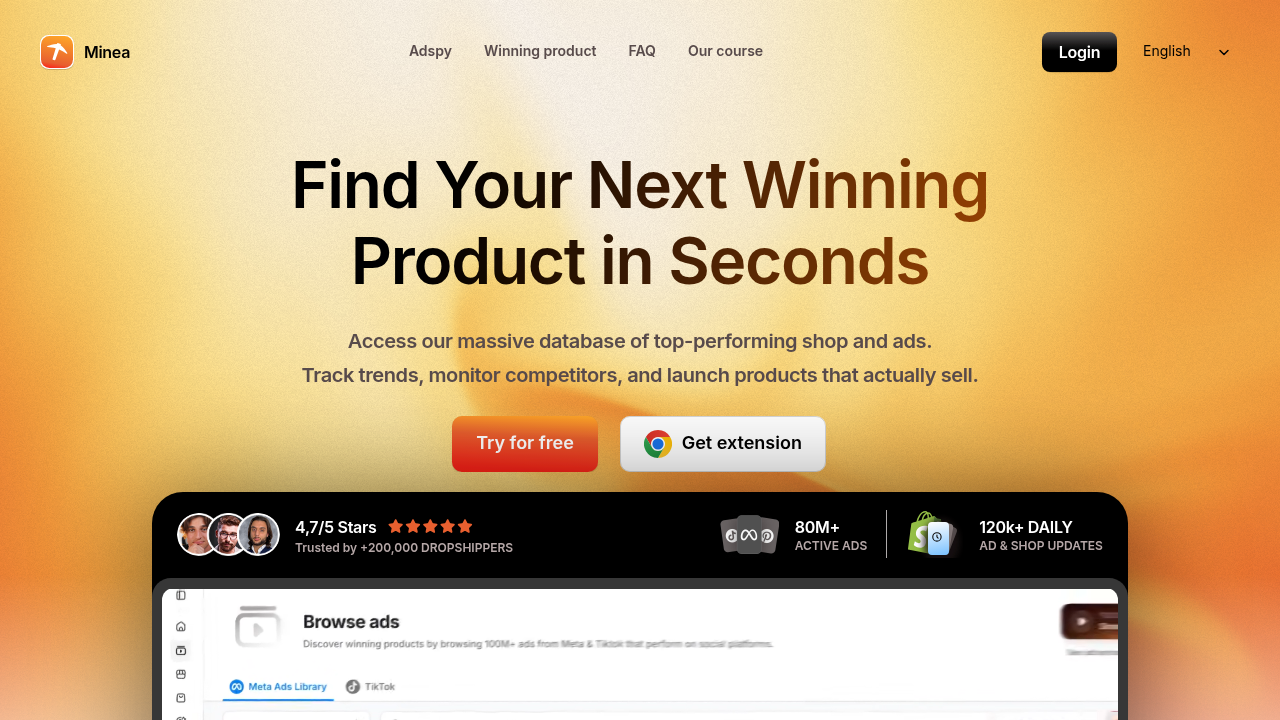
Minea is one of the most widely used ad spy and product research tools in the dropshipping space. Its main strength is the breadth of ad channel coverage — Facebook, TikTok, Pinterest, and Snapchat are all included, giving you a cross-platform view of what's being advertised.
The AI scoring feature assigns each product a "winning product score" based on engagement metrics, ad longevity, and share activity. For someone scaling across multiple ad channels, Minea gives more platform diversity than most alternatives.
Pricing starts at around €49/month for the Starter plan, with a more capable Pro plan at €99/month. There's no meaningful free tier — a small credit amount lets you test a few searches, but it runs out quickly.
Pros:
- Covers Facebook, TikTok, Pinterest, Snapchat
- AI-generated winning product scores
- Large ad database
- Influencer tracking feature
Cons:
- No free tier in practice
- Product data is ad-focused, not store-aggregated
- Can surface saturated products if filters aren't used carefully
Best for: Marketers who run campaigns across multiple ad platforms and want to spy on creatives across channels.
3. Dropship.io
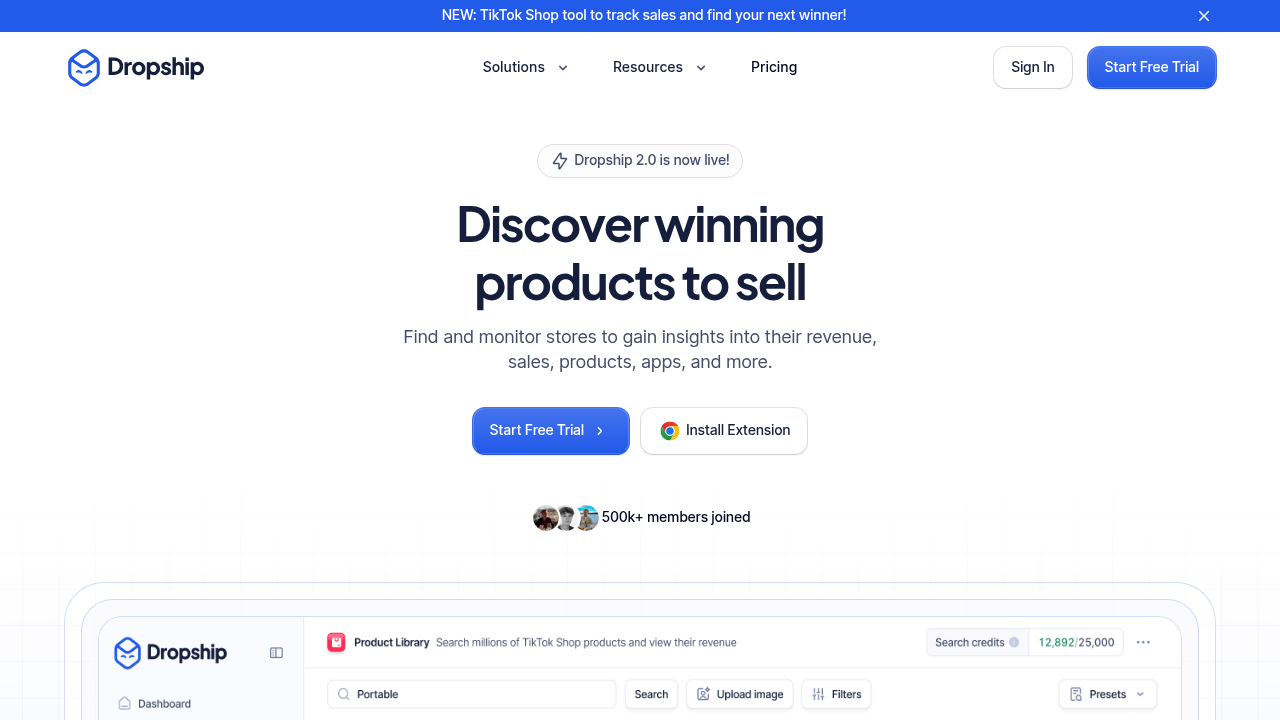
Dropship.io focuses heavily on Shopify store intelligence. The platform tracks revenue estimates for individual stores, letting you identify which competitors are generating the most sales and which products drive their revenue.
The AI-powered product research engine surfaces trending items based on store revenue data, and the competitor tracking feature is one of the more detailed in this category. You can track up to 10 competitors and get notified when they add new products.
Plans start at $29/month for basic access, going up to $79/month for the Business plan with full competitor tracking and broader data access.
Pros:
- Solid Shopify store revenue tracking
- Competitor tracking with alerts
- Clean, beginner-friendly interface
- Good data on trending Shopify stores
Cons:
- Limited to Shopify ecosystem
- Revenue estimates aren't always precise
- No cross-platform ad spy coverage
Best for: Beginners who want a straightforward tool with an accessible UI and a focus on Shopify-based competitor research.
4. Sell The Trend

Sell The Trend uses its proprietary "NEXUS" AI engine to identify trending products across AliExpress, Amazon, CJdropshipping, and Shopify stores simultaneously. The cross-marketplace approach is useful if you're sourcing from multiple platforms and want a broader signal.
It also offers store automation features — one-click product import, order fulfillment, and a store builder — making it a more all-in-one solution than pure research tools. Plans run at $39.97/month with a 7-day free trial available.
Pros:
- Multi-marketplace trend detection (AliExpress, Amazon, Shopify)
- Store automation built in
- 7-day free trial
- Product video generator included
Cons:
- Interface can feel cluttered with so many features
- AI trend signals are marketplace-data-driven, not ad-data-driven
- Less granular on ad performance metrics
Best for: Sellers who want product research and basic store automation in one subscription without managing separate tools.
5. Zik Analytics
Zik Analytics is built primarily for eBay and cross-marketplace research. Its AI-driven product intelligence scans top-selling eBay listings and AliExpress data to suggest products with strong sales velocity and low competition.
For Shopify-focused dropshippers it's less relevant, but for multi-platform sellers or those targeting eBay specifically, the depth of eBay sales data is hard to match elsewhere. Plans start at $29.99/month.
Pros:
- Deep eBay sales data
- Good for multi-platform sellers
- Niche research tools for specific categories
Cons:
- Limited value for Shopify-only stores
- Interface feels dated
- Less relevant to Facebook/TikTok ad-driven dropshipping
Best for: eBay dropshippers or sellers running across multiple marketplaces who need category-level intelligence.
Side-by-side comparison
Which tool should you use?
The right choice comes down to where you are in your business and what type of research you're optimizing for.
Use SP Product Researcher if you're running a Shopify dropshipping store and want the most complete picture of how a product performs across all stores and ads simultaneously. The fact that it's free as part of the Service Points platform — which also handles supplier sourcing, fulfillment, and AI-powered customer service — makes it the highest-value option for store owners who want research and operations in one place. Existing users particularly highlight the saturation analysis as something no other tool matches. You can explore how to find products that sell well for dropshipping to get the most out of the tool.
Use Minea if you run paid social campaigns across several platforms and need to monitor ad creatives on TikTok and Pinterest alongside Facebook.
Use Dropship.io if you're just starting out and want a clean, guided experience focused on Shopify store intelligence.
Use Sell The Trend if you want product research combined with basic automation and import tools, without committing to a full fulfillment platform.
Use Zik Analytics if eBay is your primary or secondary sales channel.
For dropshippers specifically focused on scaling margins and reducing operational overhead, pairing a strong AI research tool with a platform that also manages your supplier comparison and order fulfillment pipeline is worth the trade-off of connecting your store. Finding winners is only half the equation — being able to source, fulfill, and deliver them reliably is what actually converts research into revenue.


